
The repo for submitting my homework.
-
Affirm
-
2012
-
Founders: Max Levchin, Nathan Gettings and Jeffrey Kaditz
-
Originally the company was started to change how travelers pay for trips and other consumer products by helping them pay over installments. But Affirm quickly diversified beyond its original vision. They partnered with retailers like Warby Parker, Verizon Visible, WalMart and Room and Board to help consumers pay for goods. Now they are one of leading credit card alternatives in the retail credit market, and have expanded into beauty and apparel.
-
How is the company funded? How much funding have they received? The company was a start-up in 2012 and received $7.5M in their Series A. In 2016 they became revenue generating, and completed their Series D funding. The trend of using a mix of Later Stage VC funding and revenue continued into April 2019 when they receive $300M in their Series F.
-
What specific financial problem is the company or project trying to solve? For consumers who can't afford what they want up front, Affrim offers the opportunity to spread out the cost over time. They offer an alternative to cash and traditional credit. For retailers, Affirm helps answer questions about how to market, convert and meet the needs of customers.
-
Who is the company's intended customer? Is there any information about the market size of this set of customers? The intended customer for Affirm is any in the United States who needs to make an immediate purchase, but doesn't have access to cash or a credit card, or has a low credit limit on the card they do have. Also Affirm's service is useful for those who are new to credit (no credit history), and can't apply for a credit card. More than half of Americans are either “credit invisible” or have poor credit, making the market size is roughly more than 160M consumers. Credit Fact File, July 2016Credit_Fact_File_07-2016.pdf)
What solution does this company offer that their competitors do not or cannot offer? (What is the unfair advantage they utilize?) Affirm offers the opportunity to buy a product, and pay for it in monthly installments with terms that were transparently presented at the point of purchase. Unlike a credit card, that you sign up for under terms you keep for years, Affirm terms apply specifically to that single purchase, and the loan is offered based on recent credit considerations. With 4.9M customers on the Affirm platform, and 2,000+ merchants (large and small) Affirm is proving to be a viable, desired alternative to making purchases with a credit card.
- Which technologies are they currently using, and how are they implementing them? (This may take a little bit of sleuthing–– you may want to search the company’s engineering blog or use sites like Stackshare to find this information.) Affirm designs and develops their own software. Point-of-sale lenders like Affirm offer sign-up portals directly on the checkout pages of online shopping experiences as well as in-store options. The technology speed and accuracy means the consumer can be approved and the loan offered almost instantly, and sometimes without interest - another differentiator from credit cards.
Application & Data jQuery, JavaScript, Python, nginx, React, CloudFlare, Java, MySQL, jQuery UI, Amazon EC2, Redis, Amazon S3, Modernizr, Ruby, CSS 3, Redux, GraphQL, Flask, Swift, Objective-C, Lodash, Kotlin, OpenResty, Apache Spark, Fastly Lua, Airflow, RxJava dbt, Luigi
Utilities Google Analytics, Twilio SnedGrid, Gatsby, OpenAPI, Facebook Pixel
DevOps Docker, Jenkins, Webpack, Babel, Gradle, Jest, Roobar, AWS CodePipeline, SauceLabs, Buildkite, WebdriverIO
Business Tools Font Awesome, G Suite, TypeKit, Marketo, Medium, Contentful
-
What domain of the financial industry is the company in? Personal / Consumer Finance
-
What have been the major trends and innovations of this domain over the last 5-10 years? The Survey of Consumer Finances (SCF) is normally a triennial cross-sectional survey of U.S. families. The survey data include information on families’ balance sheets, pensions, income, and demographic characteristics. According to the SCF, between 2013 and 2016, credit card balances have become the form of debt most widely held by families, edging out debt secured by a primary residence (hereafter, home-secured debt) for the first time since the 1998 SCF. This trend continues in 2016-19.
-
What are the other major companies in this domain? Sezzle. Klarna. PayPal Credit. Afterpay. Kiva. ViaBill. Splitit. Partial.ly.
-
What has been the business impact of this company so far? Affirm has grown to nearly 5 million users, 2,000+ merchants and an estimated annual revenue is currently $112.8M per year.
-
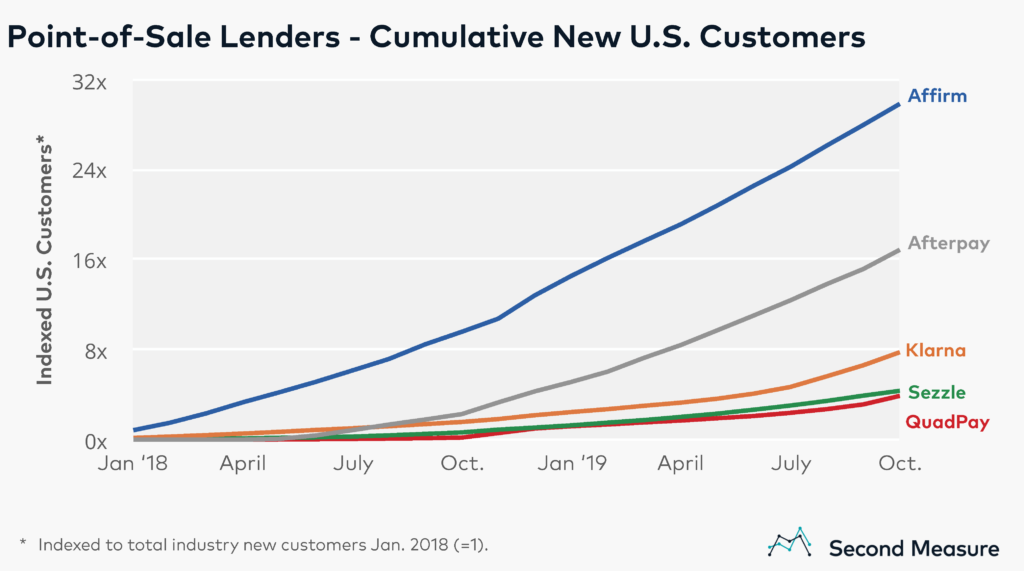
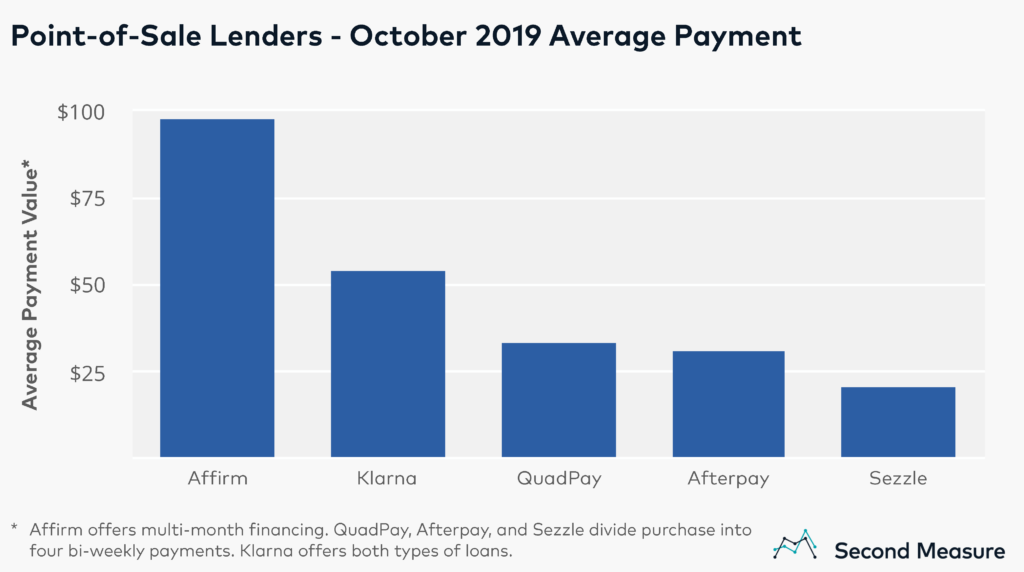
What are some of the core metrics that companies in this domain use to measure success? How is your company performing, based on these metrics? Revenue, number of customers, total monthly payments, cumulative new customers month-to-month, average customer payment amount. The company is performing extremely well on these metrics, gaining users at the fastest rate, dominating the market, and maintaining total monthly payments at a steady pace.
-
How is your company performing relative to competitors in the same domain? Affirm is outperforming all their competitors.
- If you were to advise the company, what products or services would you suggest they offer? (This could be something that a competitor offers, or use your imagination!) First, I'd advise Affirm to focus on growth of users by expanding the types of purchases they offer point-of-sale financing for. As on June 2020, only 2% of the US market has been introduced to Affirm, so there is tremendous opportunity to grow. Expanding its partnerships with merchants, will fuel their growth and commanding market share in the point-of-sale lending market (roughly 60%). For example, the partnership with Pelaton in 2020, that allowed customers to purchase pelaton exercise equiptment should become a template for future partnerships. During the 2020 COVID lockdowns, the Peloton partnership was surprisingly timely by offering an excercise alternative that was lockdown compliant, while allowing Affirm's customers to spread out payments during a time of economic uncertainty, and lack of confidence that people will have cash-on-hand. Under the current circumstances, Affirm offers a superior product to a traditional credit card. It also doesn't marry the consumer to longterm credit terms and usage fees.
Additionally, I think it's important that Affirm carves out their own cornerstone in an omnichannel strategy, and then offers it to the merchants they partner with, while enhancing their user's experience. The omnichannel approach would not only enhance their user's purchasing experinece, it would offer a very valueable enhanced experience of how to manages one's finances. The customer journey of making a large purchase is doubly fraught for milinneals, age 23-40, who already carry a lot of debt, and want to manage it simply, and straight-forwardly - characteristics already inherent in Affirm's product. The omnichannel strategy play makes even more sense when you consider how much insight Affirm gains into customer preferences, habits, and motivations. By offering a product that gives Affirm vast insight into the users own finances, and into the types of goods and merchants they are most likely to purchase from, Affirm is in a position to build tremendous brand trust and strong relationships that other traditional lenders don't have. Affirm is also seeing the entire lifecycle of loyal customers, and learning how to replicate that again and again. Their high-rates of retention validate how happy people are with the experience to date. The onmnichannel play could make them instrinsic to every purchase experience, and in that is room for tremendous expansion and growth that could ultimately challenge large financial institutions.
- What technologies would this additional product or service utilize? And why are they appropriate for Affirm? Other than financial software hosted on the cloud, omnichannel experiences leverage AI technologies to better predict and understand customer behavior. Affirm has an oppotunity to understand new customer purchasing behavior better than its competitors. Automated speech recognition and natural language processing could enhance the expereince of an autommated loan application process.
Also integrations between each technilogical componenet in the tech stack need to be pristine and operate in real time to generate that perfectly pieces together customer expereince as the customer moves from department to department.
*Appendix https://www.federalreserve.gov/econres/scfindex.htm
https://www.bloomberg.com/profile/company/1276532D:US
https://prosperitynow.org/files/PDFs/Credit_Fact_File_07-2016.pdf
https://www.nerdwallet.com/reviews/loans/personal-loans/affirm-personal-loans
https://stackshare.io/affirm/affirm
https://secondmeasure.com/datapoints/affirm-afterpay-klarna-lenders-holiday/
https://pitchbook.com/profiles/company/56914-48#overview
https://growjo.com/company/Affirm
https://secondmeasure.com/datapoints/affirm-afterpay-klarna-lenders-holiday/
https://www.mentalfloss.com/article/94623/numbers-how-americans-spend-more-their-money
https://impact.com/partnerships/buy-now-pay-later-how-affirm-is-disrupting-the-retail-credit-world/