


polytri is a fast header-only triangulation library for simple polygons with hole support, based on Raimund Seidel's randomized algorithm¹.
With an expected time complexity of
The library depends only on the STL and has no build or link dependencies.
#include <iostream>

/* Single header only. */
#include "polytri/polytri.hpp"

/* The internal PointTrait type works for types with public x / y members
 * and for anything indexable with [0] / [1] accessors (std::array, ..).  */
template<typename T>
struct Vertex {
  T x{};
  T y{};
};

/* The vertices list is expect to be a Container-type. */
template<typename T>
using Contour = std::vector<Vertex<T>>;

int main(int argc, char *argv[])
{
  /* The first contour is the outer boundary, the following ones are holes.
   * Contours can have any orientation and must not repeat their first point. */
  std::vector<Contour<float>> polygon{
    { {-10.0, -9.0}, {11.0, -12.0}, {0.0, 8.0}, {-5.0, 11.0} },   // outer boundary
    { {-2.0, -2.0}, {-2.0, 2.0}, {2.0, 0.0} },                    // hole
  };

  /* Basic usage: Returns an std::vector<uint32_t > of indices. */
  {
    auto indices = polytri::triangulate( polygon );

    for (auto const& i : indices) {
      std::cerr << i << " ";
    }
    std::cerr << std::endl;
  }

  /* Alternatively we could define a reusable Context and use any unsigned
   * index type as outputs. */
  {
    polytri::Context context{};
    std::vector<uint16_t> small_indices{};

    /* The returned Result type can be casted as a boolean and hold an error
     * message when it fails. */
    if (auto ok = context.triangulate( polygon, small_indices ); !ok) {
      std::cerr << ok.message() << std::endl;
      return -1;
    }

    for (auto const& i : small_indices) {
      std::cerr << i << " ";
    }
    std::cerr << std::endl;
  }

  return 0;
}
Any point type can be accepted by the library by specializing polytri::PointTraits.
class MyPoint {
 public:
  MyPoint(double x, double y) : x_(x), y_(y) {}
  double get_x() const { return x_; }
  double get_y() const { return y_; }

 private:
  double x_, y_;
};

namespace polytri {
template<>
struct PointTraits<MyPoint> {
  static double x(const MyPoint &p) { return p.get_x(); }
  static double y(const MyPoint &p) { return p.get_y(); }
};
}
- Contours must be simple.
- Holes must lie inside the outer contour and must neither touch nor cross each other or the outer contour.
- Vertices must be distinct points (no dupplicates).
- Invalid input (non simple polygon, fewer than 3 vertices, a contour repeating its first point) is reported by a
polytri::Resultand an empty indices vector. - All orientation tests are exact, so degenerate inputs (collinear vertices, equal
xory) are supported. - The library will refuse to compile with
-ffast-math(it breaks the exact predicates). - Segments are inserted in a deterministic pseudo random order (using
POLYTRI_RANDOM_SEED), which gives the expected running time. Without it ordered contours would takeO(n²). - A
polytri::Contextkeeps its memory between calls.
The project is shipped with demos that will fetch their own dependencies via CMake FetchContent.
cmake -S demos -B build
cmake --build build

# Interactive shape editor using raylib.
./build/editor/polytri-editor

# Benchmark against other libraries (time, memory and peak heap).
./build/benchmark/polytri-benchmark --big --csv results.csv

# Produce diagrams from the previous results.
python3 demos/compare/plot.py results.csv --out plots
You can disable individual demo targets by setting the CMake option POLYTRI_BUILD_${DEMO_NAME}
to OFF:
# Generate build files without `polytri-editor`
cmake -S demos -B build -DPOLYTRI_BUILD_EDITOR=OFFA simple Raylib editor for plotting outer and hole vertices with automatic retriangulation.
- Left click to add a vertex.
- Left click near the first vertex to close the contour.
- Right click near a vertex to remove it.
Rkey press to reset the canvas.
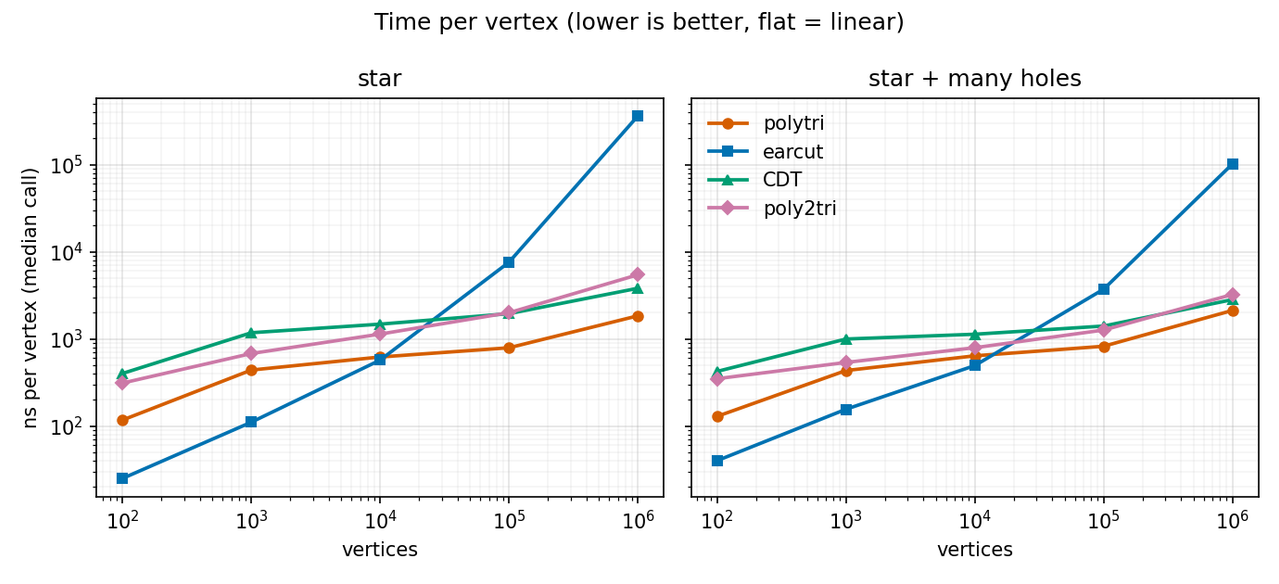
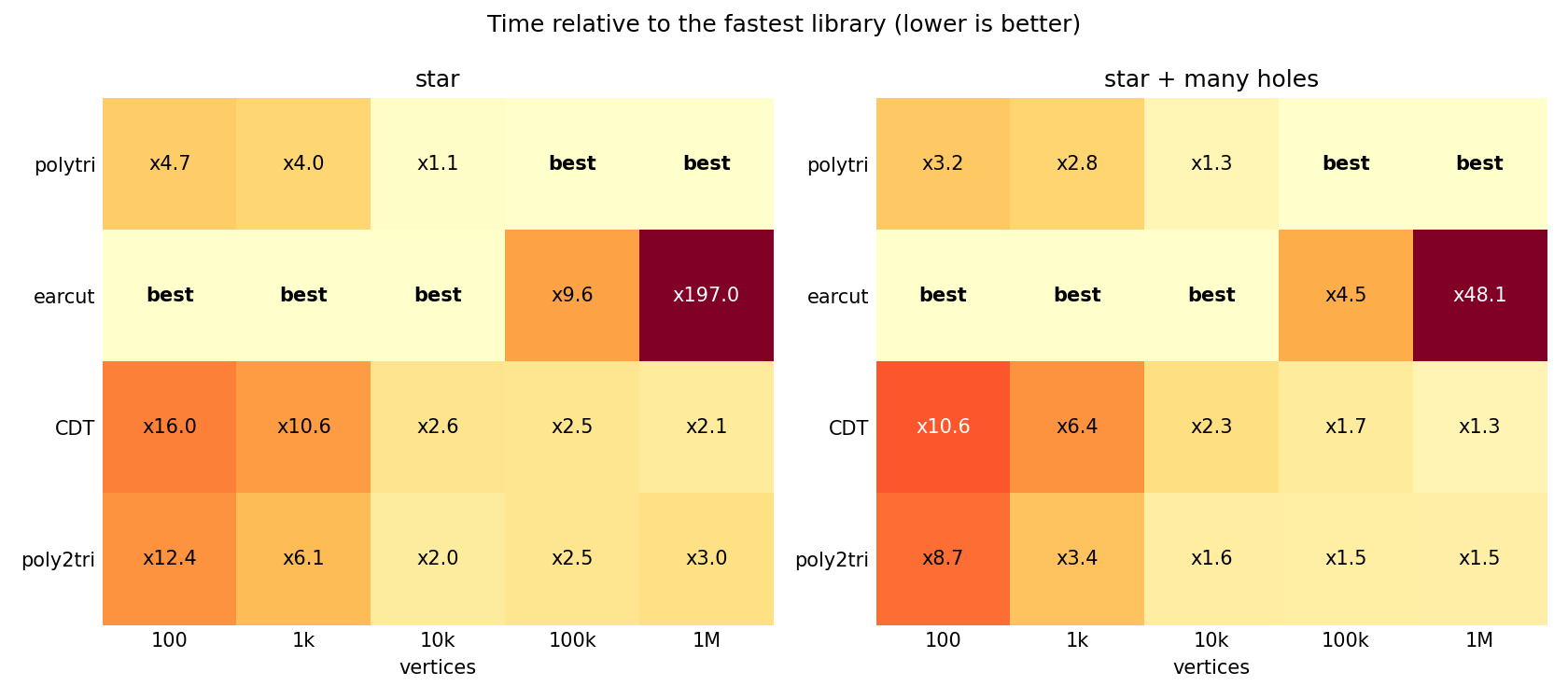
A benchmark is provided to test the library against others popular triangulation implementations :
earcut(via mapbox/earcut),Constrained Delaunay Triangulation(via CDT and poly2tri).
On a star with many holes shape, polytri outperform earcut above 10⁴ vertices and ranks second to it below that threshold.
Note that other metrics, such as triangle quality, must also be considered, for which constrained Delaunay triangulation is widely regarded as giving the best results due to maintaining near-equilateral shapes without violating structural constraints.
- R. Seidel. A simple and fast incremental randomized algorithm for computing trapezoidal decompositions and for triangulating polygons. Comput. Geom. Theory Appl., 1:51–64, 1991.
- A. Narkhede and D. Manocha, Fast Polygon Triangulation Based on Seidel's Algorithm, Department of Computer Science, UNC Chapel Hill.
- Fournier, Alain & Montuno, Delfin. (1984). Triangulating Simple Polygons and Equivalent Problems. ACM Trans. Graph.. 3. 153-174. 10.1145/357337.357341.
- M. de Berg, O. Cheong, M. van Kreveld, M. Overmars. Computational Geometry, Algorithms and Applications, Third Edition, Chap. 3 Polygon Triangulation, Springer, 2008.
This is free and unencumbered software released into the public domain.